Handmade Melody: A Font with Heart
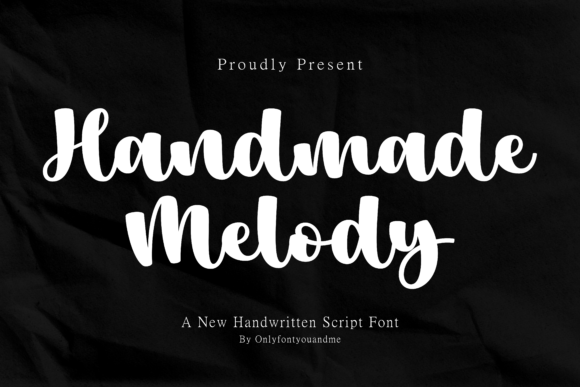
Handmade Melody isn’t just a name—it’s an invitation. It’s the quiet hum of ink on paper, the gentle curve of a letter shaped by hand, the subtle rhythm that makes a greeting card feel like a hug. As a display font, Handmade Melody combines organic imperfection with lyrical grace: its strokes swell and taper like musical phrasing, its baseline sways gently, and its lowercase letters carry the warmth of a familiar signature. It’s not designed for dense paragraphs or code editors—it shines where emotion matters most.
Why This Name Fits—And Why That Matters
“Handmade Melody” works because it names two essential qualities at once: craft and flow. “Handmade” signals authenticity—not sterile uniformity, but variation in weight, spacing, and angle that echoes human gesture. “Melody” hints at pacing, harmony, and soft transitions between characters. Together, they promise something rare in digital typography: a font that feels both intentional and tender.
That resonance is especially powerful around Mother’s Day—but its usefulness stretches far beyond seasonal cards. A teacher might choose Handmade Melody for a classroom welcome banner to soften institutional rigidity. A small-batch soap maker could use it on product labels to reinforce artisanal values. A blogger writing about grief or joy might select it for quote graphics—not for decoration, but because its rhythm supports emotional honesty.
Beginners & Hobbyists
If you’re new to design tools—or just want to make something heartfelt without wrestling with layers and kerning—Handmade Melody lowers the barrier. Its natural spacing and clear letterforms mean it often looks balanced right out of the box. You don’t need to adjust tracking to make “Happy Mother’s Day” breathe. Try it in Canva or Google Slides: paste the text, pick the font, and add a soft watercolor background. Done. For hobbyists, value isn’t in advanced features—it’s in speed, sincerity, and zero frustration.
Freelancers & Small Business Owners
When your time is billable and your brand voice must land in under three seconds, Handmade Melody offers quiet efficiency. It reads as warm but not childish, personal but not unpolished—ideal for service-based businesses (like doula practices, tutoring studios, or home bakers) where trust is built through tone as much as content. One graphic designer told us she uses it for client email headers: “It says ‘I see you’ before the first sentence even begins.” Commercial licensing is straightforward, and the font includes standard OpenType features like ligatures and alternate glyphs—enough flexibility to refine a logo lockup or social post without overcomplicating things.
Educators & Content Creators
In education, typography is a silent teaching tool. Handmade Melody helps signal approachability—especially for younger learners or adults re-engaging with literacy. Its open counters (the enclosed spaces in letters like ‘a’ or ‘e’) improve legibility at a glance, and its moderate contrast avoids visual fatigue during screen-based learning. A homeschool parent used it for weekly reading logs; a university writing center embedded it in feedback templates to soften critique. Here, the priority isn’t trendiness—it’s clarity paired with kindness.
Designers & Brand Strategists
Professionals evaluating Handmade Melody look past first impressions. They test how it pairs with supporting typefaces (try it with a clean sans-serif like Inter or Lato for balance), whether its weights hold up at small sizes (it’s best at 24pt and above), and how its personality aligns with long-term brand evolution. One studio avoided it for a fintech client—not because it’s “bad,” but because its expressive nature would clash with expectations of precision and stability. Context matters more than quality alone.
What It Does Well—and Where It Steps Back
Handmade Melody excels in short-form, high-emotion settings: invitations, Instagram story text, embroidered tote bag mockups, recipe cards, poetry broadsides, or handmade journal covers. Its charm lies in restraint—it doesn’t try to be everything. It has no bold or italic variants (those would break its handmade illusion), limited language support (Latin-based scripts only), and minimal punctuation alternatives. That’s intentional—not a gap to fill, but a boundary that preserves its character.
If your project needs multilingual menus, data dashboards, or body text for a 50-page zine, Handmade Melody won’t serve that need—and that’s okay. Good typography knows when to lead and when to step aside. Its strength is specificity: it answers the question, “How do I make this feel like it came from the heart, not the template?”
Real Uses, Not Just Possibilities
- A freelance photographer uses Handmade Melody for client thank-you notes—exported as PDFs with a scanned ink sketch behind the text. The font bridges digital delivery and tactile memory.
- A middle school art teacher prints it large on butcher paper for students to trace and reinterpret, turning typography into a drawing exercise—not a technical lesson.
- A nonprofit running a caregiver support group applies it to printed affirmation cards (“You are enough,” “Rest is part of care”). Volunteers report recipients holding the cards longer, turning them over, smiling quietly.
- A ceramicist launching an online shop pairs it with photos of her mugs—no extra styling needed. The font’s warmth mirrors the texture of her glazes.
Does It Fit Your Next Project?
Ask yourself:
- Is the message personal, celebratory, reflective, or nurturing?
- Will it appear in a place where tone carries as much weight as words—like a gift tag, a framed quote, or a homepage hero line?
- Do you value ease and emotional resonance over technical versatility?
- Are you okay with using it sparingly—where it can shine, not strain?
If yes to most of those, Handmade Melody likely belongs in your toolkit. It won’t replace your workhorse sans-serif—but it might become the voice you reach for when what you’re making needs to feel like a real person wrote it, slowly, with care.
Typography, at its best, isn’t about perfection. It’s about presence. Handmade Melody reminds us that sometimes, the most professional choice is the one that lets humanity show through.