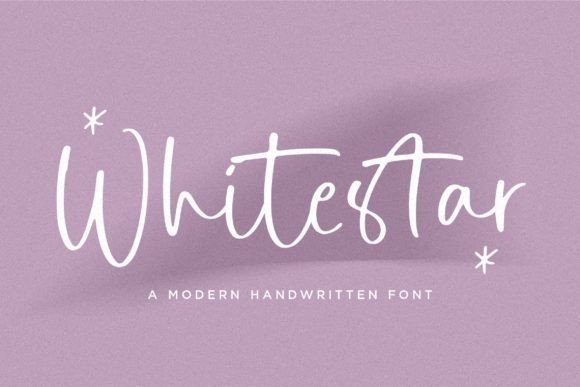
Whitestar: A Handwritten Typeface Built for Human Connection in Digital Spaces
In an era where interfaces grow sleeker, algorithms more predictive, and content feeds faster than ever, something quietly powerful is happening in design: people are gravitating toward authenticity—not as a trend, but as a necessity. Whitestar reflects that shift. It’s not just another script font; it’s a modern handwritten typeface crafted with intention—its natural rhythm, subtle inconsistencies, and organic flow mirror how real people write, not how machines render.
What Makes Whitestar More Than Just “Handwritten”
Many fonts labeled “handwritten” rely on uniform spacing, exaggerated flourishes, or overly decorative strokes—traits that can feel performative or dated. Whitestar avoids those pitfalls. Its letterforms balance control and spontaneity: the lowercase a has a gentle, open bowl; the g features a soft, single-story tail; and the capital W carries a confident, slightly asymmetrical weight. These aren’t arbitrary choices—they’re informed by gesture, pressure variation, and the quiet imperfections of ink meeting paper.
That groundedness translates directly into usability. Unlike highly stylized scripts that sacrifice legibility at smaller sizes or in UI contexts, Whitestar maintains clarity across applications—from a 14px caption in a blog post to a bold headline on a wedding invitation. Its OpenType features include contextual alternates and ligatures that activate naturally as you type, giving each word a nuanced, human cadence without manual intervention.
Why Handwriting Is Resonating—Now More Than Ever
This isn’t nostalgia. It’s response. As digital communication becomes increasingly fragmented—text messages, push notifications, AI-generated replies—readers subconsciously seek signals of presence and care. A brand that uses Whitestar in its email signature, product packaging, or website hero section isn’t just choosing a font; it’s signaling attentiveness. That matters when trust is earned in milliseconds.
Consider how small businesses operate today: many founders handle branding, web updates, and customer outreach themselves. They need tools that feel personal *and* professional—no coding, no over-engineering. Whitestar fits seamlessly into modern workflows: it’s compatible with Figma, Adobe Creative Cloud, Canva, and popular CMS platforms like WordPress and Webflow. No plugins required. No licensing surprises. Just clean, ready-to-deploy typography that supports voice—not overrides it.
Real-World Use Cases That Go Beyond Aesthetics
Take a freelance educator launching an online course. They want their landing page to feel warm and approachable—not clinical or corporate. Using Whitestar for section headers and call-to-action buttons (e.g., “Start Your First Lesson”) adds tactile warmth while keeping body text in a neutral sans-serif for readability. The contrast works because Whitestar doesn’t shout; it invites.
Or consider a local bakery updating its Instagram Stories. Instead of stock graphics or generic fonts, they overlay Whitestar on photos of sourdough loaves or seasonal tarts. The font’s slight irregularity echoes the handmade nature of their products—no two croissants are identical, and no two rs in Whitestar look exactly alike. That alignment between craft and communication strengthens perceived authenticity.
Even in B2B contexts, subtlety matters. A SaaS startup introducing a new dashboard feature might use Whitestar for the release announcement headline (“Meet Your New Workspace”) paired with a clean geometric typeface for supporting details. The combination conveys innovation *and* empathy—two traits users increasingly expect from tools that shape their daily work.
Evolving Expectations—and How Whitestar Fits In
Five years ago, “brand personality” often meant selecting a single typeface and sticking with it rigidly. Today, flexibility is non-negotiable. Design systems now routinely include primary, secondary, and expressive typefaces—each serving a distinct emotional or functional role. Whitestar occupies that expressive tier: not for body copy, but for moments where humanity needs emphasis—launch announcements, handwritten-style testimonials, limited-edition product tags, or even animated loading messages that say “We’re here” before the interface fully renders.
That evolution mirrors broader shifts in user behavior. People scroll past polished, algorithm-optimized content daily—but pause for something that feels intentionally made. A logo set in Whitestar on a business card stands out not because it’s flashy, but because it implies time was spent. That perception carries weight in crowded markets, whether you’re selling ceramics, consulting services, or digital courses.
Practical Tips for Getting Started—Without Overcomplicating It
You don’t need a design degree to use Whitestar well. Here’s what works:
- Pair thoughtfully: Combine it with a restrained sans-serif (like Inter, Lato, or Work Sans) for balance. Avoid other script fonts—Whitestar thrives when it’s the sole voice of warmth in a layout.
- Respect hierarchy: Use it for headlines, quotes, logos, or short labels—not paragraphs. Let it breathe. If it appears too often, its impact softens.
- Test in context: Preview how it renders on mobile screens and in dark mode. Whitestar’s medium weight holds up well, but avoid ultra-light variants for accessibility-critical text.
- Think beyond print: Try it in email subject lines (if supported), video subtitles, or even custom 404 pages. Small touches build consistency without overwhelming.
And if you’re evaluating fonts for a rebrand or new project, ask yourself: Does this typeface support the feeling I want people to have *after* they interact with my work? Not just “modern” or “clean”—but “seen,” “understood,” or “welcomed.” Whitestar answers that question with quiet confidence.
Not a Replacement—A Refined Tool for Intentional Communication
Whitestar won’t replace system fonts in your operating system, nor should it. Its value lies in specificity: it’s designed for moments where tone matters as much as information. That’s why designers, marketers, educators, and small business owners reach for it—not to follow a trend, but to meet evolving expectations with integrity.
Technology continues to accelerate, but human needs remain steady: clarity, connection, and recognition. Whitestar doesn’t fight digital efficiency—it complements it. It reminds us that behind every interface is a person, and behind every brand is a story worth telling with care.
If you’ve hesitated to use handwritten typefaces in the past—worried they’d feel gimmicky or unprofessional—you’re not alone. What’s changed is the availability of options like Whitestar: refined enough for serious work, expressive enough to carry meaning, and built for the way people actually create and connect today.